

Financial Habits: A System for Building a Sustainable Money Foundation

Financial habits are not just about spending or saving. They are the patterns behind the money decisions you repeat every day. Many people have a stable income but still struggle to keep money because their financial behaviors are not yet clear or consistent.
When money comes in and goes out quickly, the issue is often not only about salary level. What usually makes personal finances unstable is poor cost control, limited cash flow tracking, and the lack of clear rules for how money should be used.
This article will help you understand what financial habits are, why they directly affect your ability to keep money, and how to start changing them through simple steps. From there, you can build a stronger financial foundation for saving, investing, and reaching long-term financial goals.
Table of Contents
1. What Are Financial Habits?
Understanding financial habits in daily life
Financial habits are the repeated behaviors behind how you earn, spend, save, and track your money. They determine whether your money is kept or quietly slips away, which is why they directly affect your ability to control everyday expenses.
How financial habits differ from financial goals and a financial plan
Financial habits are the repeated actions, while financial goals are the destination and a financial plan is the roadmap. In simple terms:
- Financial goals: Specific money outcomes you want to achieve within a certain period of time.
- Financial plan: A roadmap for allocating income, spending, saving, and investing to reach those goals.
- Financial habits: The money behaviors you repeat regularly that determine how you keep and use money.
2. Why Are Financial Habits Important?
They help you manage money better
Good financial habits help you clearly see what comes in, what goes out, and what is left after each pay period. When you track expenses regularly, it becomes easier to spot what should stay the same and what needs to change so you can manage cash flow better (Ref. CFPB).

They help reduce emotional spending
When you have clear rules for how you use money, you are less likely to shop based on emotion or make rushed decisions before thinking things through. This is especially important with small recurring expenses, because they can quietly eat into the money meant for bigger goals.
They help you save and invest more consistently
Financial habits do not create results in one moment. They make a difference through steady repetition week after week and month after month. When setting money aside becomes routine, it becomes easier to keep saving and investing instead of only doing it when you happen to have extra money left over.
They help you get closer to your financial goals
Financial goals define where you want to go, but financial habits are what help you follow through long enough to get there. In simple terms:
- Goals tell you what you want to achieve.
- Habits help you maintain the actions required.
- Results come from simple changes repeated consistently over time.
3. Signs Your Financial Habits May Not Be Healthy
You do not know where your money went by the end of the month
This is a common sign that you are not tracking spending by category or by time period. When you cannot clearly see your cash flow, it becomes hard to control expenses and even harder to change repeated spending behaviors.
You earn money but still struggle to save
If money comes in regularly but your balance stays low, the issue is often your financial habits, not just your income level. Many small, repeated expenses can quietly reduce the amount you have available for saving and investing.

You buy things before giving yourself enough time to think
It is easy to spend emotionally when you do not have clear rules in place before making a purchase. This habit can weaken your budget control and slow down progress toward your financial goals.
You rarely review your finances
When you rarely look back at your income, expenses, and savings, small problems can continue for months without being noticed. Regular reviews help you catch issues earlier and adjust your financial habits in a simpler, more realistic way.
4. The Core Types of Financial Habits You Should Build
Spending control habits
The first group of financial habits is spending control, because this is where money leaves your account every day. When you track expenses regularly and separate needs from wants, you can see more clearly which costs are worth keeping and which should be cut to avoid ongoing waste.
Saving habits
Another important group of financial habits is saving consistently instead of waiting to see what is left at the end of the month. A more effective approach is to treat saving as a fixed priority, so the money you build up does not depend entirely on motivation or whatever remains after spending.
Cash flow management habits

These habits help you understand when money comes in, when it goes out, and whether you have enough for essential expenses. When you understand your cash flow, you can organize bills, fixed costs, and flexible spending more proactively and avoid falling short.
Long-term investing and wealth-building habits
Financial habits are not only about keeping money. They also support building wealth and investing with long-term goals in mind. What matters most here is starting with a plan, staying consistent, and understanding that lasting results usually come from discipline rather than short-term decisions.
Financial review and adjustment habits
The last group of financial habits involves reviewing your finances regularly so you can spot problems and adjust early enough. In simple terms:
- Reviewing helps you clearly see changes in spending and what money is left.
- Adjusting helps your plan stay aligned with your goals and current reality.
- Staying consistent makes money decisions more stable, simple, and sustainable.
5. 10 Good Financial Habits to Start as Early as Possible
Track your income and expenses
One of the most important financial habits is keeping a clear and consistent record of the money coming in and going out. When you can see your real cash flow, it becomes easier to control expenses and identify what is reducing your money each month.
Set spending limits before each month begins
Spending limits help you decide in advance how much money will go to essentials, wants, and savings. This makes your financial habits less dependent on emotion and gives you a simple framework before new expenses appear.
Save before you spend
Many people only save what is left at the end of the month, but a more sustainable approach is to set money aside as soon as income comes in. This habit gives savings priority before small recurring expenses can quietly take over.
Avoid emotional spending
Without clear rules, it is easy to spend quickly because of mood, discounts, or the feeling that you deserve a reward. A good financial habit is to pause before buying, think about whether you truly need it, and ask whether it will throw off your current budget.
Keep a separate emergency fund
An emergency fund helps you avoid breaking your financial plan when unexpected costs show up or income becomes unstable. That is why an important financial habit is to keep this money separate and maintain it consistently instead of mixing it in with everyday spending money.
Pay debt on time
Paying debt on time protects your cash flow, reduces interest and fees, and helps prevent financial obligations from getting out of control. When this becomes a fixed habit, you stay more proactive about what you owe and are less likely to feel short on money.
Check your finances regularly
Reviewing your finances weekly or monthly helps you notice changes early in your income, expenses, and remaining balance. A good financial habit is not just recording numbers, but also reviewing them regularly so you can adjust before a problem becomes bigger.

Set clear money goals
Clear goals give each money decision more direction instead of letting you react only to short-term needs. When your financial habits are tied to a specific destination, it becomes easier to stay committed to saving, investing, and building wealth over time.
Keep learning about personal finance
Financial knowledge does not replace discipline, but it helps you understand how to use money better, evaluate options more clearly, and avoid emotional decisions. A sustainable financial habit is to keep learning steadily so your changes are based on understanding, not just short-term motivation.
Save and invest consistently
Effective saving and investing usually do not come from one big action. They come from doing it consistently over a long enough period. In simple terms:
- Starting early gives your money more time to grow.
- Staying consistent helps you keep discipline when income changes.
- Persistence helps financial habits create stronger long-term results.
6. How to Build Financial Habits Without Feeling Overwhelmed
Start with one small change
To build lasting financial habits, start with one small change that feels manageable enough to keep doing every day. It is better to choose a money system that fits real life than to create one that feels too heavy from the beginning.
Attach the habit to a fixed point in time
A simple method is to tie money behaviors to a fixed moment, such as payday or the weekend. When a new behavior happens at the same time repeatedly, it becomes easier for it to turn into a routine and less dependent on motivation.

Track only a few simple numbers
You do not need a lot of metrics. You just need a few numbers that reflect your real financial situation. For example, track:
- How much money is left after essential spending
- How much you save each month
- Whether your flexible spending is increasing or decreasing
Adjust instead of giving up
If one month does not go well, what matters most is adjusting your approach instead of quitting altogether. This makes financial habits feel less stressful, more realistic, and more aligned with your long-term goals.
7. Where should beginners start developing good financial habits?
Get clear on your current cash flow
Beginners should start by clearly seeing what money is coming in, what is going out, and what is left after essential spending. Once you can see your cash flow in actual numbers, you will understand which habits are helping you keep money and which are causing it to slip away.
Cut unnecessary expenses
After you understand your current cash flow, the next step is to reduce expenses that are not truly necessary or that happen too often. This creates room for better financial habits to work instead of being canceled out by small repeated costs.
Set up automatic saving
Next, make saving automatic so it depends less on emotion and memory each month. Automatic transfers are a simple way to make saving more stable over time.
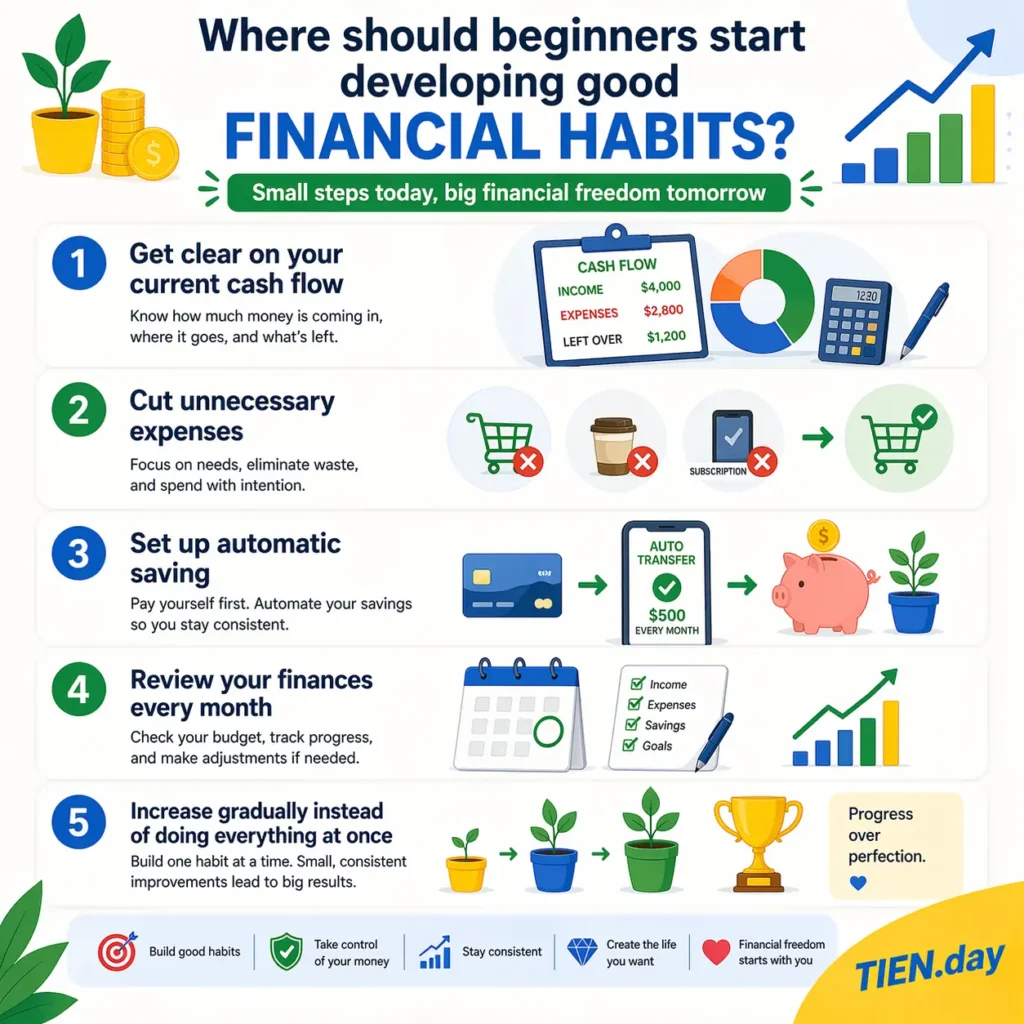
Review your finances every month
The final step is to do a monthly review so you can see what changes are working and what still needs adjustment. This helps your financial habits become more sustainable, more realistic, and more connected to your long-term money goals.
Increase gradually instead of doing everything at once
Many people give up early because they try to track spending, cut expenses, save, and invest all at the same time from day one. A more effective approach is to increase discipline gradually after one behavior has already become stable, because financial habits are built on steady repetition, not short bursts of effort.
8. Common Mistakes People Make When Building Financial Habits
Trying to change everything at once
Many people start with strong motivation but try to fix all their money behaviors in a short period of time. That approach often leads to overload, making new habits hard to maintain and easy to lose after just a few weeks.
Trying to save without controlling spending
Saving is hard to sustain if you do not know where your money is going or which expenses are driving costs up. Strong financial habits usually start with spending control, because that is what makes it possible to protect money for long-term goals.
Having goals but no tracking system
Money goals show direction, but without regular tracking, it is hard to know whether you are moving forward or backward. In that situation, financial habits can remain good intentions on paper instead of real changes in daily life.
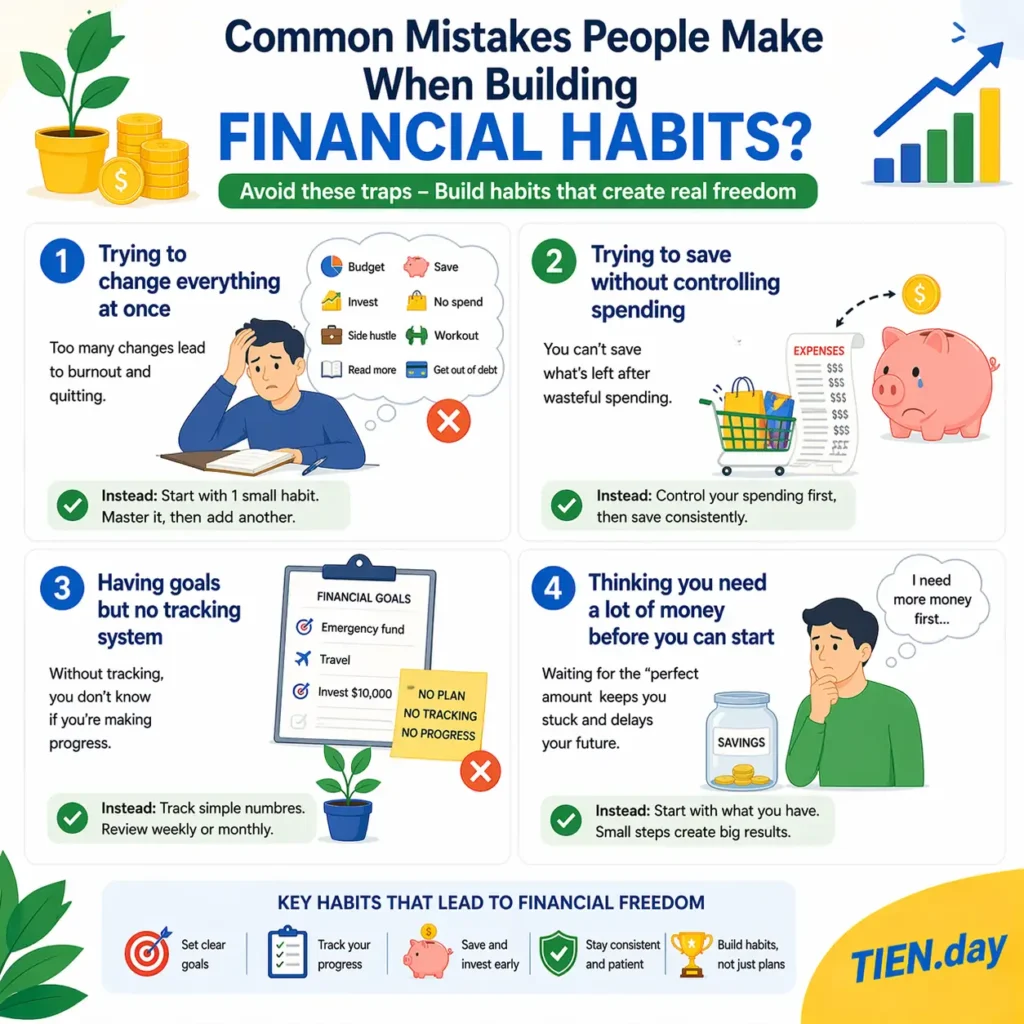
Thinking you need a lot of money before you can start
This belief causes many people to delay building a solid personal financial foundation for too long. In reality, good financial habits usually begin with small changes, small amounts of money, and frequent repetition.
Frequently Asked Questions About Financial Habits
-
Can people with low income still build good financial habits?
Yes. Good financial habits do not begin with having a lot of money. They begin with using the money you already have in a clearer, more consistent, and more controlled way with each income cycle, even if the amount you can save at first is still very small.
-
Should I track money daily or monthly?
It depends on your lifestyle and spending patterns, but most beginners do well with quick daily tracking and a monthly review. This helps you see short-term cash flow while also spotting spending trends and your ability to save more clearly.
-
What is the most important financial habit for beginners?
The most important one is knowing where your money is going. When you regularly track income, spending, and what is left, other habits like saving, spending control, and financial review have a stronger foundation and become easier to maintain.
-
How long does it take to see results?
You may notice a change in awareness within a few weeks, but clearer results usually appear after one to three months. What makes the difference is not speed, but consistency. Financial habits need to be repeated long enough to become part of your routine.
What Should You Read Next If You Want to Improve Your Financial Habits?
To improve your financial habits in a more sustainable way, it helps to keep reading articles that go deeper into specific money behaviors. Taking it one small area at a time makes it easier to understand the issue and apply it in real life at each stage.
- Personal finance management: helps you build a clearer foundation for managing money
- Saving money: useful if your current goal is to build a stable savings habit
- Managing personal cash flow: worth reading if you want to track money coming in and going out more closely
- Financial goals: helps connect daily habits to a specific destination
- Financial psychology: helps you see financial habits as part of a bigger long-term picture.
- Financial freedom: The Right Way to Understand It and a Practical Roadmap
Conclusion
You do not need to read everything at once. Start with the topic that is closest to your current problem, then work step by step so change feels simpler and easier to maintain.
Financial habits are the foundation that make personal finances more stable, clear, and sustainable over time. When you understand where your money is going, what it is being used for, and how much is left, controlling expenses becomes much more practical.
What creates meaningful change is not one strong short-term decision, but small adjustments repeated consistently over time. That steady consistency is what helps you keep more money and move closer to your financial goals.
Start with the most basic steps: control spending, save consistently, and review your finances every month.
Vietnamese: Thói quen tài chính: Hệ thống xây nền tảng tiền bạc bền vững.
References: